Seeing the Matisse exhibit at the Grand Palais and variations of Canal Saint Martin
I went to the Grand Palais a few Fridays ago on a hot summer’s day, on what was either the start of a heat wave or the end of one, to see the latest Matisse exhibit. I took the morning off from work, telling myself I’d go straight home after the exhibit and stay focused, as I had several projects that were overdue.
The Grand Palais is a large exhibition venue that sits close to the Seine and next to hardly anything interesting. (It’s a 20 minute walk to the nearest good café, which is a chore because after spending an hour or two looking at art I always want a coffee.) At any given time, the venue holds three or more exhibits, or expos as they’re called by the French (“go to expos” is a common desire expressed by women on Hinge in Paris, along with finding a guy who “makes me laugh” and “is on the left politically"). As you walk around the palace you’ll see tourists and locals alike trying to figure out which queue corresponds to their expo of choice. When I went the Palais was showing, in addition to the Matisse exhibit, an exhibit by Swedish occultist Hilma af Klint and an interactive Leandro Erlich exhibit where an optical illusion makes it look like you’re climbing up the facade of a Parisian apartment, but only if you go with someone who will take your picture.
Like all things in Paris, the Grand Palais has a history full of crossovers. Construction began in 1897, giving it time to be completed by 1900 when it was used to host the world’s fair. Matisse himself, when he was around 30, and in need of some money to make ends meet, painted decorative friezes for the Palais and while he never exhibited there when he was alive, a friend1 told me that every summer there’s a Matisse exhibit in Paris, like some sort of penance.
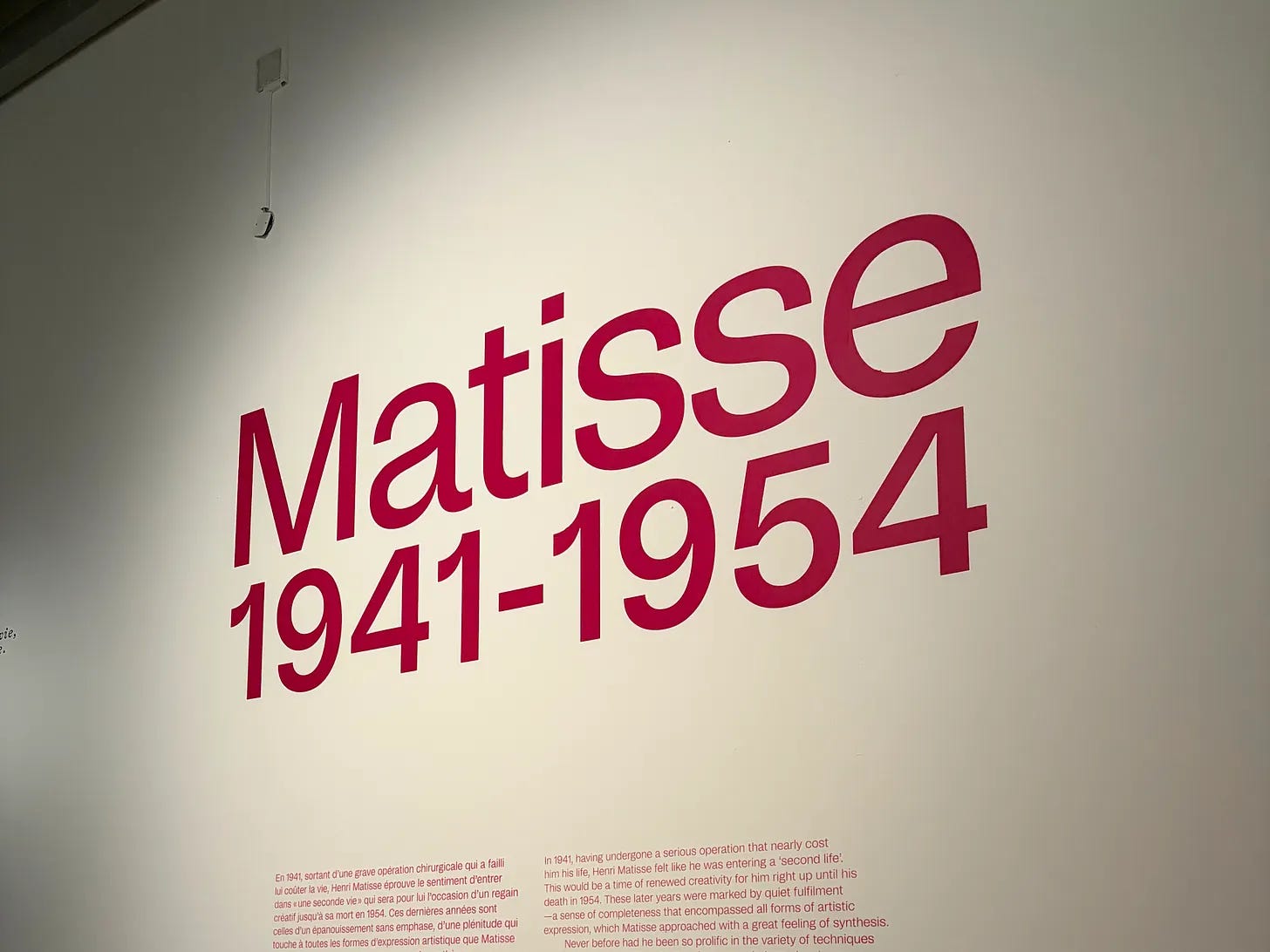
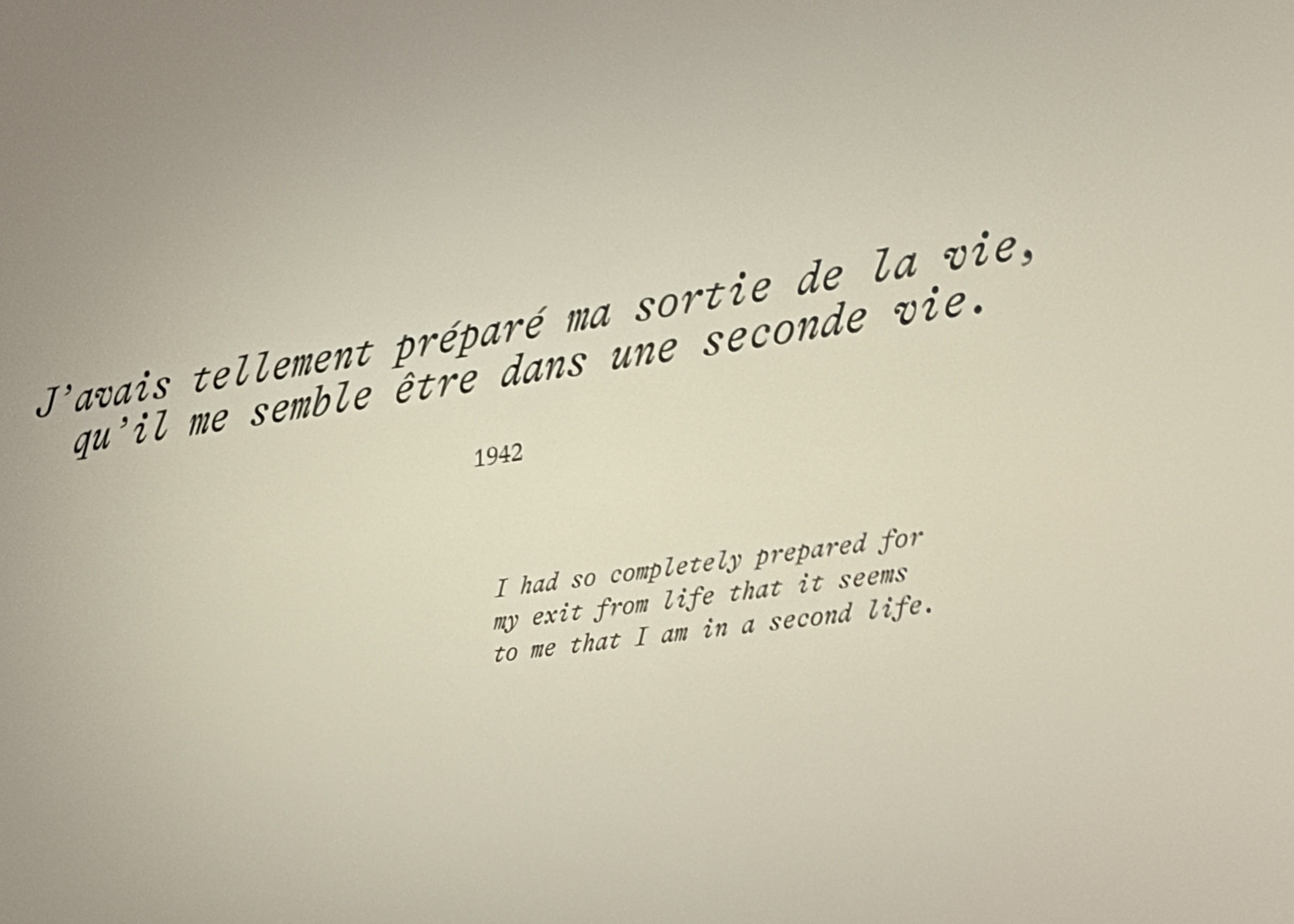
This specific exhibit covered the later years of Henri Matisse’s life, starting from 1941, when he was 71, after he had undergone abdominal surgery for duodenal cancer, up to his death in 1954. To treat his cancer, doctors had to cut out the cancerous part of his intestine, the duodenum, and connect the healthy parts of his intestine back to each other. As a result of the surgery, and its recovery, he developed a pulmonary embolism, which is when a blood clot forms in the deep veins of your body and a fragment of that clot breaks off and travels to your lungs, decreasing blood flow and oxygenation, and thus adding strain to the lungs, heart, and rest of the body. At this time, there wasn’t much to do for a clot but to convalesce, that is sit and wait it out, to try your best, by doing nothing, or as little as possible, hoping the body dissolves the clot before it makes matters worse. Imagine the effect of that; there’s a clot somewhere in your veins and if dislodged in just the right way, another fragment can break off, travel up to your lungs, putting fatal pressure on your already tired heart. For Matisse, this forced convalescence led to a weakened state, as well as a hernia and infection. All of this made Matisse a shell of his former self, at least physically, and greatly affected how he would produce art in what he referred to as his short yet productive “second life.”
For example, Matisse is most famous for his cutouts, which I didn’t know were cutouts until I saw them in person, though now of course it’s obvious. How else could color pool so uniformly across paper?
These cutouts came out of his second life. Here’s perhaps the most recognizable one: Icarus.
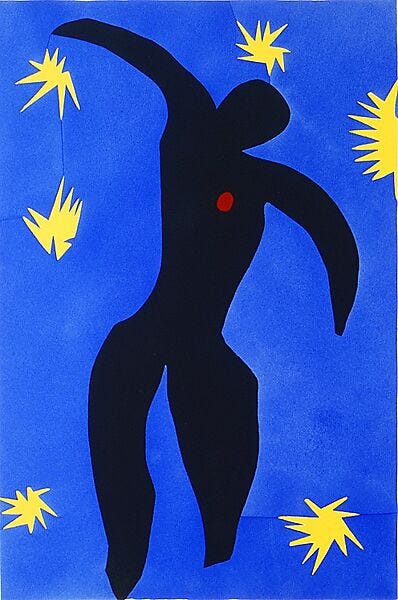
You’ve seen it screened on t-shirts or framed in guest bathrooms across the US.
These cutouts came about as they were, more or less, all he could handle as an artist, especially an artist who liked to create variations on his work. He was too weak to paint as he had once painted. But he was able to find freedom and artistic expression once he picked up scissors and started cutting.
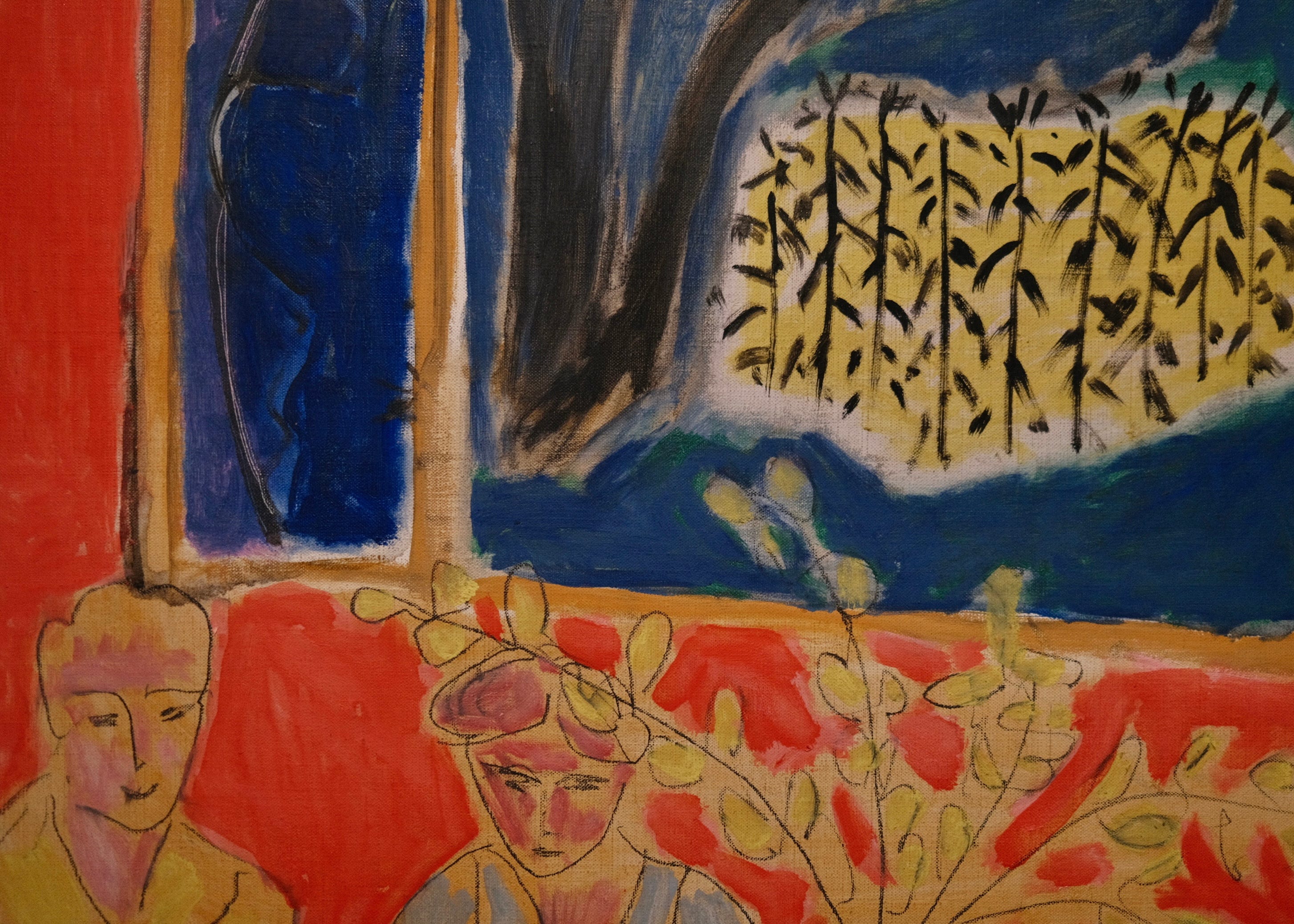
And while I respected, or at least held a fondness towards, the image of an old, frail artist, hunched over, cutting paper with scissors — how childlike we become the older we get — and using whatever tools he could to still, despite his shortcomings, express himself, what I liked most from the exhibit was a series of paintings he did of a room in Nice, back when he was still painting.
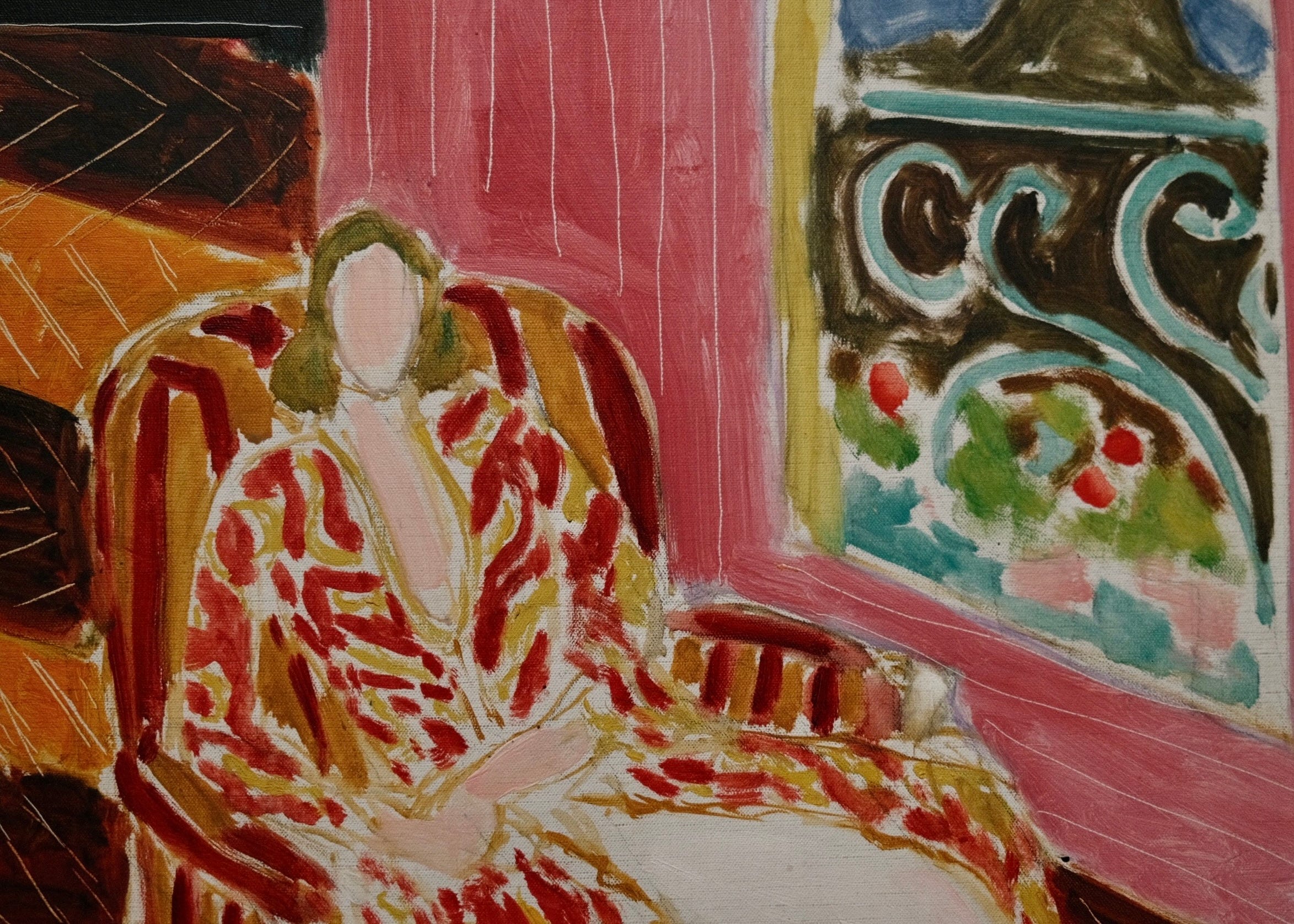
In the exhibit, a plaque introduced several paintings, calling them “variations on a theme.”
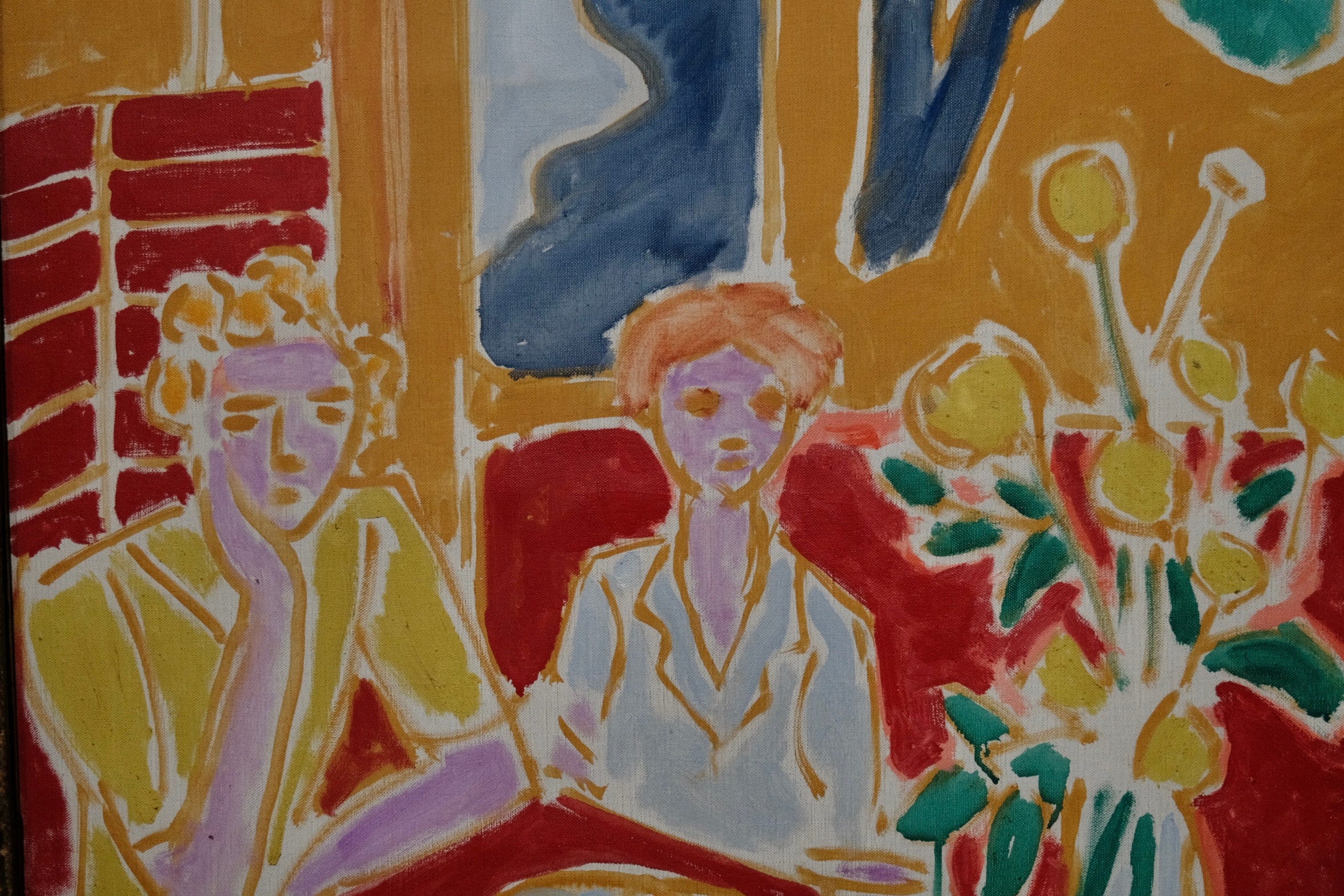
In one series, he painted several variations of a woman in front of a window. In another series, he painted several variations of two women in front of a window. (Talk about range.)
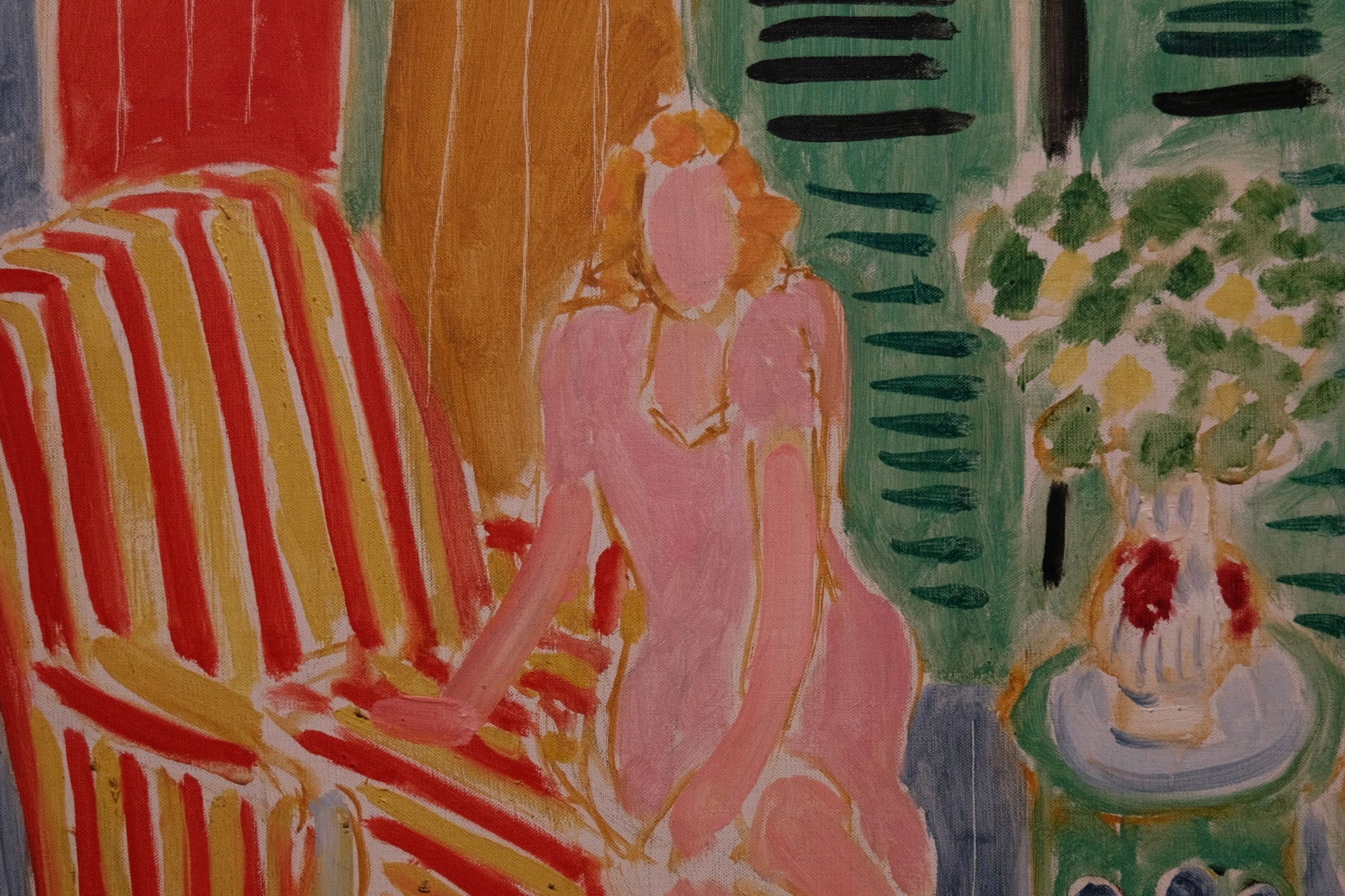
In the paintings, he changes the color schemes, he changes what is in the window, he changes the POV, where the details are.
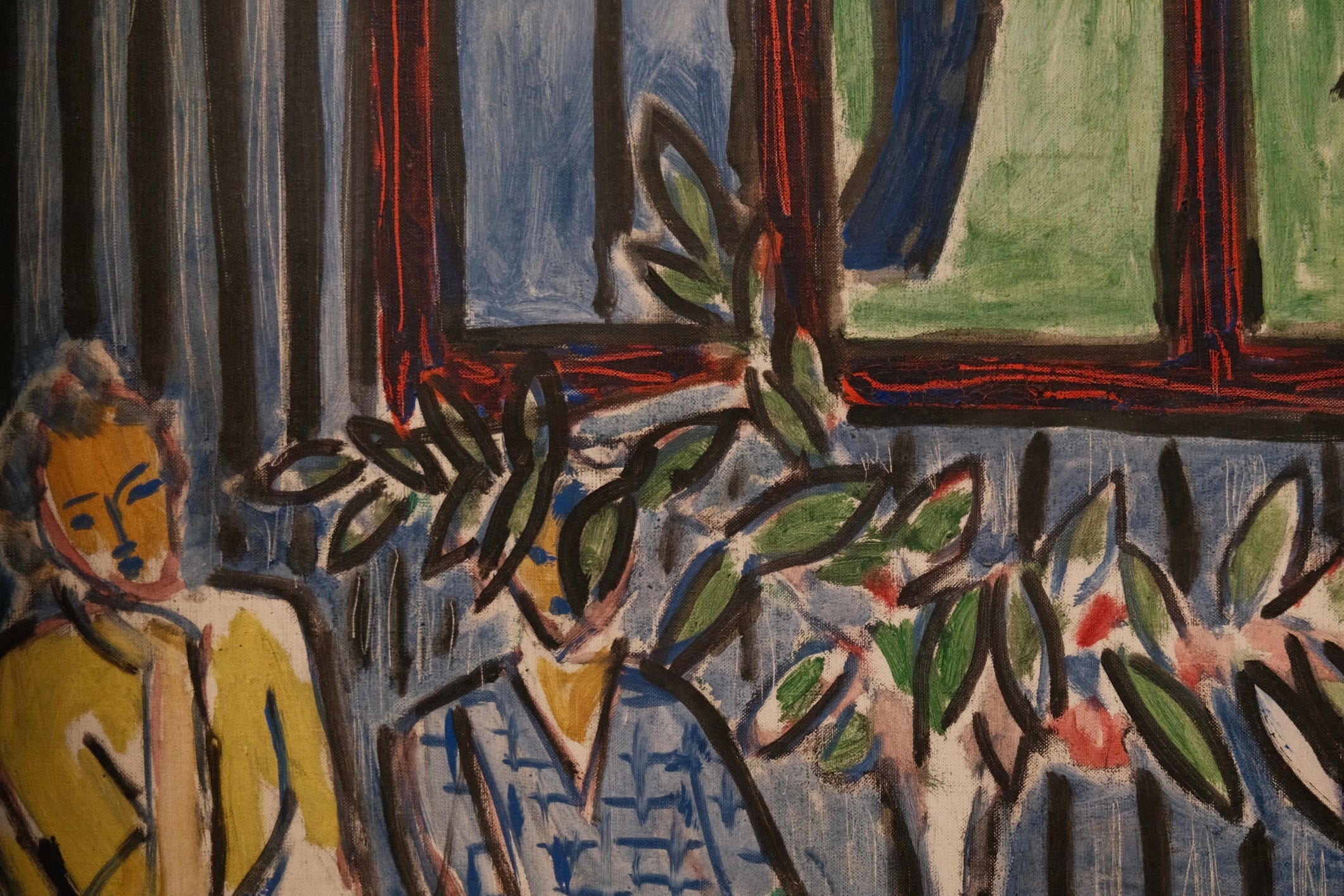
And in doing so, of course, he changes mood and the impact on the audience.
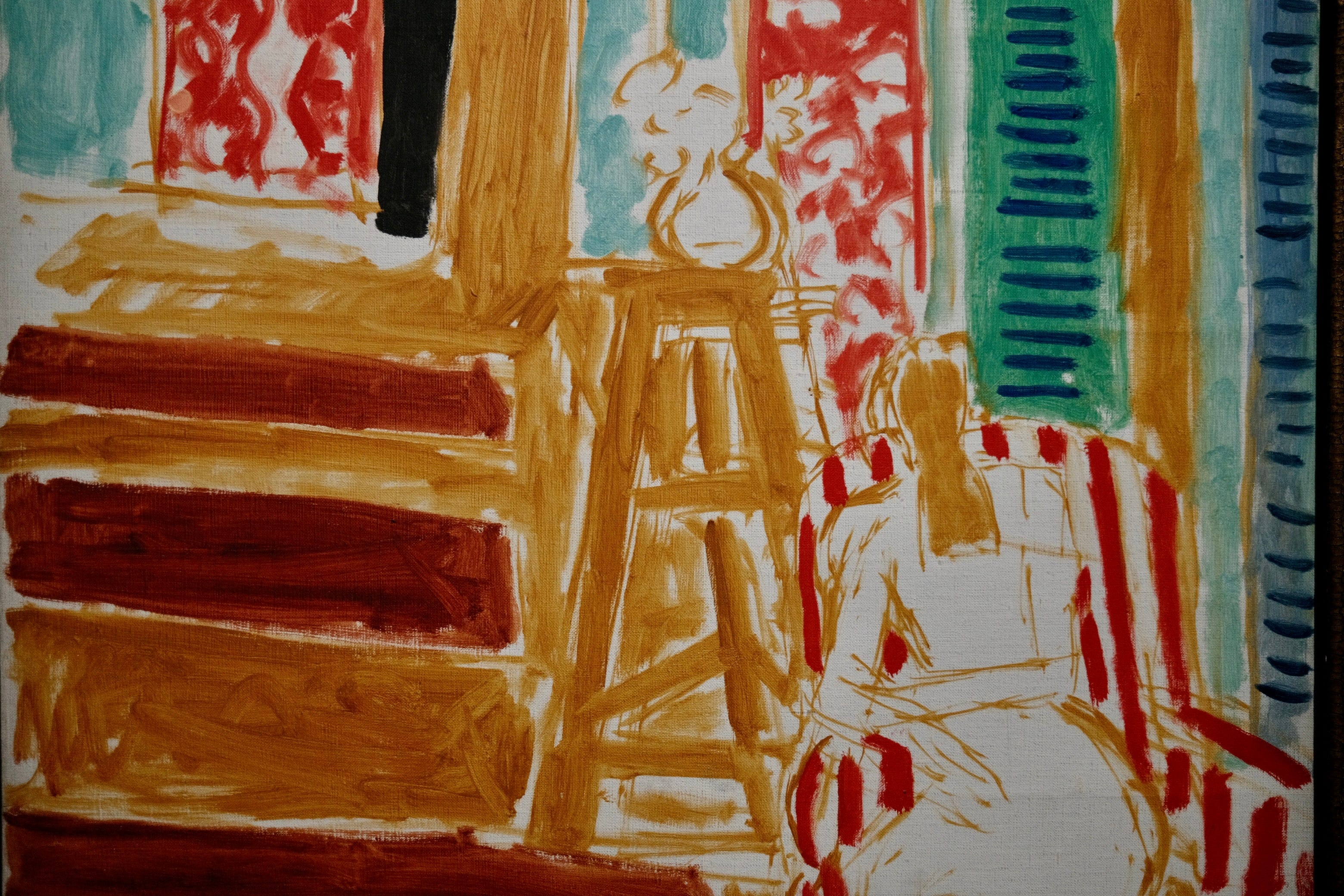
Even as he was frail, bandaged, convalescing, and herniated, with his new cutout methodology, he thrived on creating variations.


I found this focus on variations liberating, especially because, as a writer, I’m always trudging towards a final draft of something.
Variations on a theme: Canal Saint-Martin
After the Matisse exhibit I took the creaky old line 9 to République, then walked to the Canal where I was going to meet L— for mid-day drinks. I needed to work, but L— was struggling a bit in her relationship, or lack of a steady relationship, and had texted me, which she rarely ever does, so I felt compelled to meet her for a drink or two, especially after she said she’d even come to my side of town. Plus, I didn’t want to go home. It was hot as hell outside, which meant it was hotter than hell in my apartment.
I walked along the Canal looking for a good spot to have a drink and as I did, I thought of all the scenes I had seen unfold along the Canal ever since I moved near here, over a year ago now.
“Snow on the Canal in January”
You can’t tell if it’s morning or night. The colors don’t give away the time of day. The whole scene is depicted in two shades of blue (dark blue and darker blue), black, grey (like cigarette ash), and white. The white in the scene is mostly snow, which has fallen along the Canal and continues to fall, in little specks that dance chaotically through the thin January air. We’re looking at the Canal atop a bridge, over the heads of two people. A man and a woman. We don’t see their faces, but the backs of their heads. The man has a black beanie on and a green scarf. The woman has blonde hair, shockingly blonde, perhaps because it stands out against the otherwise dark and subdued picture of a grey winter. They are standing close together but you cannot tell if their arms are interlocked.
The focus of the scene is not on the Canal in front of the two people but the scenes in the periphery.
Most of the snow you see on the ground is smooth, though there is a series of footprints leading to, off in the distance, the smallest smudge of a person. You likely wouldn’t spot the smudge as a person if it were not for the footprints. Beneath us is a bicycle courier who has stopped and, one foot on the ground, is taking a photo of the Canal with his phone. He’s bundled up and wearing a yellow reflective vest.
Off to the right, near the intersection, a group of 3-5 people are throwing snow at each other. As you keep looking, you spot several other people, some merely shades, along the Canal taking photos of the snow.
If you stand real close, you can see, on the right side of the man, that’s the side away from the woman, he’s carrying at his hip a camera. But he is not taking a photo like the other people in the scene. He is looking off to the right, where a large streetlight illuminates the dancing snowfall more clearly.
“French boys shoot their shot with a woman at The Cork and Caban”
A bright, sunny day at the Canal. There are rows of people on both sides of the Canal. There are a few people swimming inside the Canal, but they’re hard to see. The streets are busy with a courier driver on a scooter whizzing by and three cyclists riding close together. Children and teenagers in swimsuits hurry past the crowds, making their way to the bridge so they can jump into the Canal once again. Everyone’s body is shining a little. In fact, there are so many people at the Canal and the sun is so bright that most of these people blur together. Plus, you’re not looking at the Canal directly, but through the reflection of the dirty glass windows of The Cork and Caban, an Irish Pub with a handful of differently sized tables lined up against the bar, where people are drinking and smoking.
You can see through the window to the people inside the pub, though you can only distinguish a few of them, including an older man with a bald head and a grey beard, the kind that would have a bald patch just under his chin, laughing an open-mouthed laugh. He’s looking out the window, not at the Canal, but at the table outside, directly across from him, where a woman sits with a nearly empty pint glass, remnant foam clinging to the sides, as teenage boys shoot their shot.
The woman is lobster pink. She’s wearing a short black dress that looks more like a nightgown. It was probably the most breathable item of clothing she owned. Her feet hover over her pair of green flip flops, which she had slipped out of a beer ago. She’s looking at the boys next to her, but the sun is very bright. She’s holding her long-fingered hands over her eyes like she’s trying to discern whether the water out on the horizon is a mirage.
The three boys standing next to the table are between the ages of 10 and 15. They’re wearing swim suits, wet from the Canal water. Their hair is slicked back. They have sunken-in, ill-defined chests, the way boys do when they have not grown into their body. They have knobby knees and long legs. One of the boys is half leaned over, with his hand on the table. He is wearing red swim trunks which stand out, especially when contrasted with the other two boys, one who is wearing dark green shorts and the other wearing black basketball shorts which aren’t meant for swimming, so he has to keep one hand at his waist to stop them from falling.
Maybe the boy in the red swimsuit is asking for her number. Maybe he is just telling her she’s beautiful and that she deserves better than the man she is with. The two boys stand behind their more bold friend, wide eyed and smiling, on the verge of cracking up. But the boy in red swim trunks seems dead serious. It’s only if you stare at his face for a good amount of time that you’ll see in the corners of his mouth and in corners of his eyes a small smile that will, once she finally rejects him and tells him to get lost, turn into a full blown cackle.
The man who she’s with is oblivious to the scene unfolding. He has two pints of beer, one in each hand, arms lifted high above his chest, as he tries to make his way past the crowded bar inside, back to their table.
“A young woman and young man sit by the Canal on an early morning in September”
On a cool morning in late September — not yet fall, but summer is behind us — a young woman, wearing a light track jacket zipped all the way up, worn-in blue jeans, chalky white around the knees, and old sneakers that she’s used as beaters for the past few years, leans back on a wooden bench on the Canal, posing for the man next to her. The man is holding an old film camera up to his eye. The woman’s dirty blonde hair is in a messy bun, the shape of a lop-sided orange. On the ground next to her is a large, stuffed-to-the-seams red duffle bag.
If you look closely at her face, you’ll see slight indicators of age: crow’s feet eyes, a mouth downturned, a small sag under her chin. But mostly you’ll see freckles and pink-splotched skin and an upturned nose, rosy at the tip.
The man takes a photo and then winds the shutter and checks the exposure indicators in the viewfinder. There’s a red plus sign when it’s overexposed, a red negative sign when it’s underexposed, and a green circle when it’s just right. He looks through the viewfinder, then pulls the camera away and looks at the woman with his naked eye, then brings the camera back up again. He turns the focus ring until her face precipitates into a sharp clarity. It’s a heavy camera. Soviet. There’s Cyrillic on the bottom battery compartment. The man has a thin camera strap around his neck. Through the viewfinder he sees the woman’s smile. A slightly uncomfortable smile. The smile of someone not accustomed to being photographed, perhaps. Or perhaps she has something to say and doesn’t know how to say it. The man himself is smiling, a greedy smile, though the top half of his face, from his nose up, is focused.
The man is her age or near it, either a little older or younger. He has laugh lines around his small mouth. He is wearing a button up long sleeve shirt, a black sweater, beige pants, bright green dress socks, and shiny, un-scuffed derbies. His hair is coiffed in the front, but the back is messy, as if he had got up early and only did the part of his hair he could see in the mirror.
The two of them are sitting on a bench near the Canal. It’s very early in the morning. The streets are quiet. Soon this Canal will be bustling with people, but the only indication of that is the trash left over from the night before, the odds and ends, a few beer bottles and cans and empty packs of cigarettes, the remnants of a crowd. Down the Canal nearly out of view (neither of them show indication that they see this) a homeless man sleeps barefoot on a bench out in the sun. The bottoms of his feet are black and you’d be forgiven for thinking he was wearing socks.
Because the sun is not above the Canal yet, the Canal water looks dark blue. Every now and then a bottle of soda or beer or a plastic bag will bob up and down the Canal.
There’s both a closeness and a distance between the young man and the young woman. It may be a date or a reunion or a farewell. She is drinking hot chocolate. If you lean in closely you can see a faint chocolate mustache on her lips. The man is drinking an espresso, its small cup near his shoes. It’s unclear if he wants to kiss her, if she wants to be kissed, if they’ve kissed before, if the idea is crossing their mind, if it has never crossed their mind, etc. But it’s clear from the clothes that they’re wearing that they did not wake up in the same world or if they did then they’re not going to the same place.
After one drink, L— and I had another, then walked to a different brasserie (God knows why) and switched from beer to Aperol spritz. The inescapable sun — even when we found shade, the sun’s light found us, reflected and refracted on the shiny metal of passing cars, storefront windows, and even the bodies of others — made each drink more impactful. Alcohol drunk and sun drunk, L— and I walked from République towards the 9th, where S— was having drinks with so and so. But I also had an invite heating up my phone from D— who was in Belleville. I felt dizzy. Part of me still believed that I could go home, have a shower, and get some work done.
After about ten minutes of this wandering, L— asked ”Which way are we going?”
Even when sober, so much of Paris looks the same to me. In this new home of mine, I can walk and walk without feeling like I’ve made an intentional decision. The streets simply unfold, the city continues. I say it’s the effect of Haussmannian architecture but L— says I just don’t have an eye for noticing the city’s many variations. She’s probably right. In writing, especially in revising, when I’m filtering through versions towards that final draft, I can spot variations and their effects, but in real life, whatever internal observer I have at my disposal goes blind. Drop me in any arrondissement and unless I’m by something incredibly noteworthy, a landmark or famous restaurant, I wouldn’t be able to tell you where I am or how I plan to get where I’m going.
Not really a friend.