Angelo You Cheating Bastard + Les Mis at Sondheim Theatre with Hostel Beers After (London Part One)
7:40 am Eurostar from Paris to London. The young woman in the seat in front of us is stumbling through the final stages of a (likely overdue) breakup. She’s speaking on the phone, and while she doesn’t whisper, she isn’t loud. She speaks clearly, like she’s ordering a meal from a waiter, a waiter she doesn’t have much confidence in, repeating twice that she wants the sauce on the side. I see her only in glimpses, always her side profile: a sharp chin, tannin skin, unruly chestnut brown hair. She’s wearing large, thick eyeglasses. I can see through them and out the train car window to a blurred French countryside. She’s buried under layers of clothes, maybe even a scarf. When she pushes a strand of hair out of her face, her skinny arm extends out of three sleeves, each different in texture and color: a dark woolly forest green; a synthetic deep maroon; and an off-white cotton, the kind of thin undershirt with long sleeves that hook around your thumbs. But I can’t see her completely, though I try repeatedly. I want to know if she’s beautiful. I strain my neck, trying to wrap my eyes around her seat, but no luck. Say I met her tomorrow in London — perhaps she’s also staying at Wombat’s, perhaps she’s also doing the Bermondsey Beer Mile — she could walk right by me and I wouldn’t even know. I’d only recognize her again if I heard her speak. She speaks with a shallow therapeutic tone, like an HR manager asking you if you thought your comments in the morning meeting were “work appropriate.” She likely learned how to describe the emotional depths of her heart the same way she mastered English, clearly her (at least) second language, by watching cheesy, made-by-numbers films produced by Netflix.
Miji and I have our Kindles out, but both silently agree that this current story unfolding in front of us is more engaging because it’s fleeting, whereas our books will be here long after this moment is gone.1
Here’s what we can put together about the woman in seat 86:
Her boyfriend on the other end of the line is named Angelo and is presumably back in Paris. She says his name far too often, the way you would — and I’m just spitballing here — to a friend who is teetering on a ledge, as if by saying their name enough times you can summon forth the version of them that wouldn’t jump.
She and Angelo had talked in the past about being in an “open” relationship, but they hadn’t defined the terms, leaving key questions like “what is open?” and “what is relationship”? unanswered.
She had gone to Angelo (when is uncertain) and expressed a desire to “get to know” someone that she had a “casual” interest in. (I want to be on your side, Seat 86, but this intentionally vague wording is fooling no one and clearly did not fool Angelo. Her direct stance is “I just wanted to explore him,” him being the other man. Each time she says these words that she thinks are pacifying, I myself clench, as if she were hurting me.
Angelo responded to her desire to “explore” someone else by having sex with someone else. No, not just someone. A friend. Or someone among their shared mutuals, as he refuses to tell her who exactly he had slept with.
Not all of this is said directly. We have to deduce from what we can hear. Unfortunately, we can’t hear Angelo speak, not even a mumble. While I’m not much interested in his side of things, I’m dying to know the words he uses to express his side of things, what his English is like, his accent, his intonation. Does he sound genuine, or conniving in his (at least) second language? I imagine him speaking only in the imperative.
The woman repeats herself throughout the call. A tell-tale sign that a relationship is ending. Not because, as you might think, that the person you’re speaking to isn’t hearing what you’re saying, but because you’re not hearing you, so your brain has you repeat the words again and again, as many times as it takes until their meaning is revealed to that deeper part of you that can, for example, finally let you off the hook, so you can wake up one day and not think about the person you swore you’d never stop wanting in your life. But for now the young woman in seat 86 is still not hearing herself. She talks about “moving past” this incident, but she is also adamant that she needs to know who he slept with, and here her true voice cracks through, a slight yelp under that calming, patronizing tone.
Angelo isn’t spilling the beans (smart man), and moments before the Eurostar dives under the English Channel, the convo — and the relationship? — is over. From what we can hear, there was no final definitive goodbye, no “can we talk later,” no “I’ll call you when I get to London,” no “I hate you and never talk to me again.” There was only silence followed by teary wet sniffles that seemed half-assed, faintly fading into the humming white noise of train car 6.
It was around here that I dozed off, into one of those short but heavy naps, where you go straight from shut-eye to the deepest, pillow-laden cranny of REM sleep. When I woke up, we were in England. A ping notification on my phone from Free Mobile: 35Go de data, c’est royal isn’t it ? Bienvenue au Royaume-Uni. Light from the day once again entering the train car, though not directly filling up our aisle, as we’re in a row with no window.
For no reason whatsoever, I woke up with the poem “What He Thought” (by Heather McHugh) on my mind, as if I had been discussing it with Miji before falling asleep. I say “for no reason whatsoever” as the poem isn’t about Paris or London or open relationships or men named Angelo or young, self-deceiving women who spend so much time labeling their wants they cannot actually feel their desires.
The poem is about a group of writers (bleh) in Italy (bleh) on a writers’ retreat (bleh!), but despite all of these annoyingly clichéd trappings the poem has something interesting to say and its message (or more accurately its images and the sounds of the words read aloud) has been stored away in a broken-lock filing cabinet in my mind since I first encountered the poem, back in my early twenties, on the Southern and Dobson Mesa Community College campus, where raspy-voiced Josh R., the director of the creative writing program, taught us the poem. Like all poems that have stuck with me, there have been times throughout the years, seemingly without a cause, where a gust of cranial wind blew through my cerebral cortex, shook the cabinet open, and gusted sheaves of paper around my consciousness, just like it did while sitting on the morning Eurostar with Miji, the first part of our weekend trip to London.
The poem opens with poets from America in Italy who are surrounded by their “counterparts . . .among the Italian literati,” including “the academic, the apologist, the arrogant, the amorous, the brazen, and the glib.” The speaker spends a good amount of time describing one odd-ball out, referred to as “[t]he administrator (the conservative).” He wears a dull grey suit, is in charge of the itinerary, and during the retreat spoke to them plainly (i.e., not poetically) about sights and history of Rome.
Over dinner one of the poets asks, “What’s poetry?” (bleh). Is poetry fruits, vegetables, bread, Coke Zero in a sweating glass, or is it a statue, a painting, a song? The speaker, genuine and naive — a stand-in for us — blurts out what was “easiest to say,” that is, that poetry “is both,” both the mundane and the sublime. But that isn’t a satisfying answer, not to us, not to the speaker.
Then the man in the grey suit, the boring man, the non-poetic man, begins to answer, “all of a sudden with a rising passion.”
He tells the group of American poets about Giordano Bruno, a 16th-century Italian philosopher and cosmologist, who was “brought to be burned in the public square / because of his offense against / authority, which is to say/ the Church. His crime was his belief/ that God is no / fixed point or central government, but rather is / poured in waves through all things.”
The poet-in-disguise continues his story, sharing that “the day they brought [Bruno] / forth to die, they feared he might / incite the crowd. . . so his captors / placed upon his face / an iron mask, in which / he could not speak. That’s/ how they burned him, that is how/ he died: without a word, in front / of everyone.”
The grey man concluded his point, and even now I can still hear, reverberating in my mind, Josh R.’s raspy voice in that small Mesa classroom delivering the punch: “and poetry — poetry is what he thought, but did not say.”
~
I check on the woman in seat 86. She isn’t crying anymore, at least not audibly. She’s editing a story she’s about to post on Instagram. I can’t see what it is, but I can see her fingers resizing the font of whatever it is she’s typing.
In an attempt to make this a proper travelogue, let me try my best to recap the day for you, possible future London visitors.
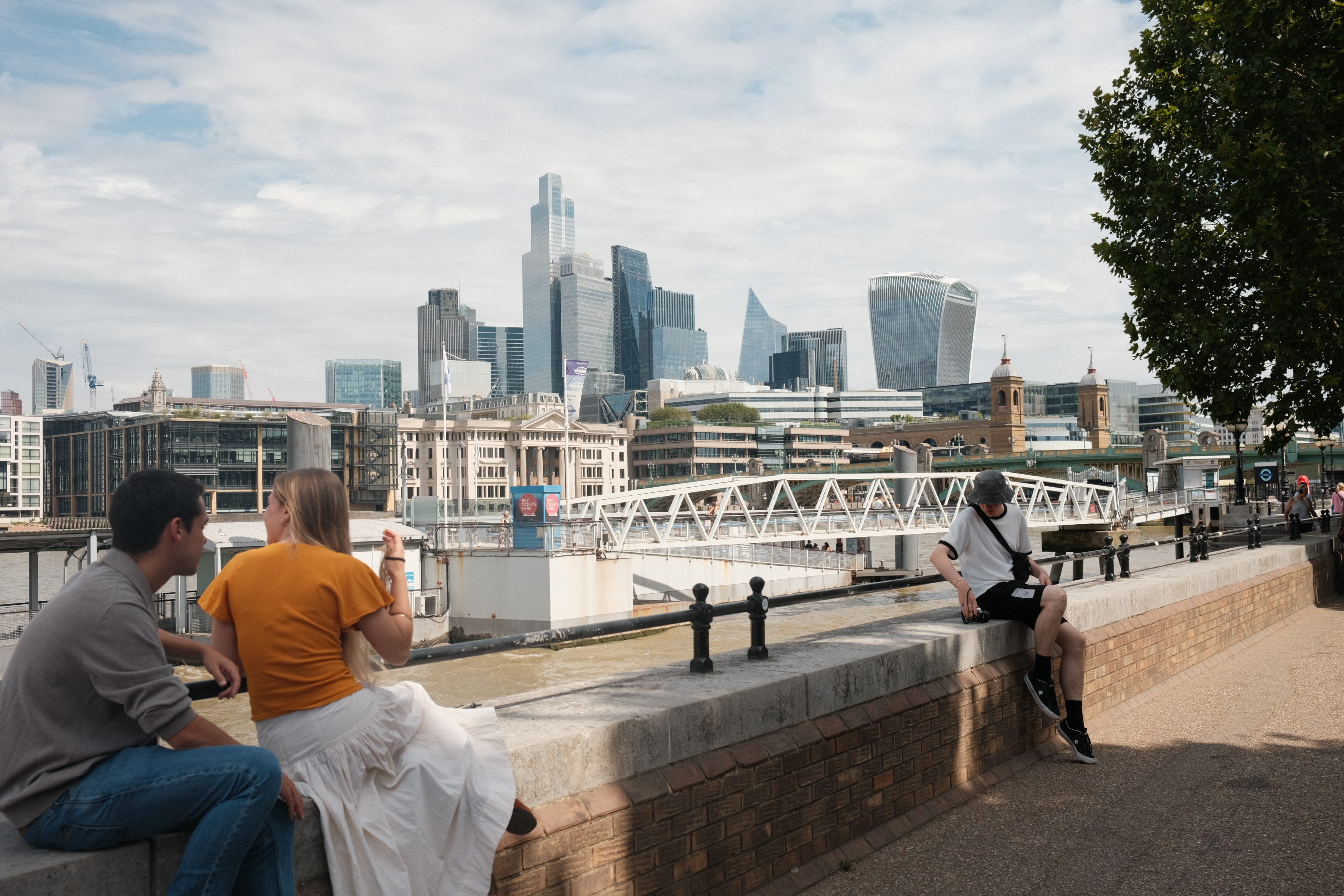
St. Pancras station, 9 am. A perfectly bright sunny day, with streets split in two, where I can walk in the cool shade while Miji walks in the warm sunlight. It’s a day of staying in motion. First, we get breakfast: eggs on toast with sausage and spicy mustard and a cold brew at Prufork cafe, where I make a joke with the waitress. Oh, how good that feels. Here I can expand my personality to fill a room. Dumb dad jokes, small talk. Every place I walk into feels as if it had been waiting for me. After breakfast, we drop off our bags at Wombat’s, then walk around Brick Lane, finger shopping at vintage markets, looking over books I need to read and clothes I’d never touch, then we eat again, despite not yet being hungry, an underwhelming rare steak from Flatiron with the béarnaise sauce and a side order of truffle mac and cheese. Another cold brew, this time at Hermanos Coffee Roasters. Check in at the hostel, have a quick shower, then two hours walking through all the wings at the National Gallery (see the images below).


Something I do now that I didn’t do before when visiting a city: Looking up beforehand which pieces of art are on display in the city’s museums, a real quick search, looking for something that catches my eye, something I’d like to see in person. For London, I found The Execution of Lady Jane Grey by Paul Delaroche, the first in the gallery below, which depicts Lady Jane struggling to find (on account of being blindfolded) the execution block where she was to lay her head. And as you pursue one piece of art, you’ll surely find others.


After the gallery, a pint at The Harp, followed by dinner at Barshu (salt and pepper soft shell crab, fragrant chicken in a pile of chiles, dry-fried green beans with minced pork, and mixed gyoza), we went to Sondheim Theatre, where we had tickets to see Les Misérables. I had ballooned up so much from overeating, drinking, and caffeinating. Miji had to roll me up the steps to our side balcony seats overlooking the stage and the audience.


There in the surprisingly comfortable seats with a great view, I digested the day. My body began to cool. The sun on my skin finally dissipating. I didn’t know what to expect with the show and with the theatre.
But here’s what there was: a skilled cast singing their heart out and a lazily dressed audience (everyone looked more like they belonged in line for an amusement park) that cheered and roared so loudly after each big number that I half expected Jean Valjean to rip off a piece of his clothing and throw it to all his squawking admirers.
11:30 pm. Back at the hostel, in the underground hostel bar. We arrived just in time to hear the last karaoke song of the night, three young women singing Billy Joel’s Piano Man (the kids are alright). Miji and I are both drinking hazy IPAs, sitting off to the side of the bar. I had tried to find a table not so close to the speaker, but the whole damn area was loud. You can’t really talk. When karaoke ends, it doesn’t get quieter. Instead, the bartenders turn up the “White Gurl Wasted” Spotify playlist they have pulled up.
I’m tired as all hell, but I don’t necessarily want to sleep. Miji must be exhausted. Just around two days ago, she had been in South Korea, visiting family. During that trip, she had also gone to Japan for a bit. Before she was in East Asia, she was in Paris for a few days, and before that, Réunion Island, visiting her boyfriend’s family. Before Reunion, she had gone to Ibiza. Before that, Morocco, where she battled a nasty ear infection that lasted the entirety of her dirt-stained, camel-riding trip.
Now, London. A morning that started around 5 am or so. Non-stop movement from the time the train arrived at St. Pancras. Now, a hostel bar. A heartfelt rendition of the Piano Man followed by a disco ball sparkling its shimmering lights over an empty dance floor while Crank That by Soulja Boy plays. (The kids are not alright.)
I first met Miji over a year ago when I, on a pub crawl, crashed a language exchange group she was in at Le Violon Dingue in the Latin Quarter. Back then, she was as unhappy as it gets: hated her job, her boyfriend was out of the country, and Paris isn’t her city (she wants the ocean, she wants sun, she wants metros that don’t smell like piss, she wants kindness). Now things are looking up. She doesn’t work at that job anymore, her boyfriend is back home, where they’re raising a cat as an only child (risky). Paris still isn’t her city, but nothing is forever, and travel helps. Through the highs and lows, we bonded over two simple interests: drinking beer and reading books.
Sometimes when we meet for drinks, she doesn’t say much, at first. I’ve learned to let a quietness exist between us, to be comfortable in that silence, and then she’ll eventually fill it. Because I don’t speak French, the language she is most comfortable expressing her thoughts in, after her native tongue, we talk in English. I don’t think she’d call herself fluent, though I’d call her fluent. That doesn’t mean there aren’t misunderstandings. Sometimes I can tell she didn’t quite get what I said. She will make a face like the one my hard-of-hearing dad makes when we speak at a decibel that his old, weathered cochlea can’t quite pick up. A shallow nod and a fake chuckle. But rather than a fake chuckle, Miji makes a concentrated face, like she’s trying to do algebra in her head. Sometimes I clarify, but other times I let the misunderstanding linger. More and more, having a friend (especially a friend you found in your 30s, in a country far from your home country, in a country far from her home) requires having a bit of faith that they will, despite instances of miscommunication, understand who you are or that you will, if it comes down to it, survive being misunderstood.
At the hostel bar, we will have two drinks, but then cut ourselves off, mostly because we are still full. And besides, tomorrow is the big drinking day. We have plans to have the first pint at 2pm, and drink our way through the 20-ish pubs that make up the Bermondsey Beer Mile.
I’m reading Pnin by Nabokov and Miji is reading a book on time in Korean, Hangul's rigid and highly manufactured characters just look more intelligent than this Latin script of ours that you’re reading now.