Cologne and Berlin
Photos and travel notes from my trip to Cologne and Berlin
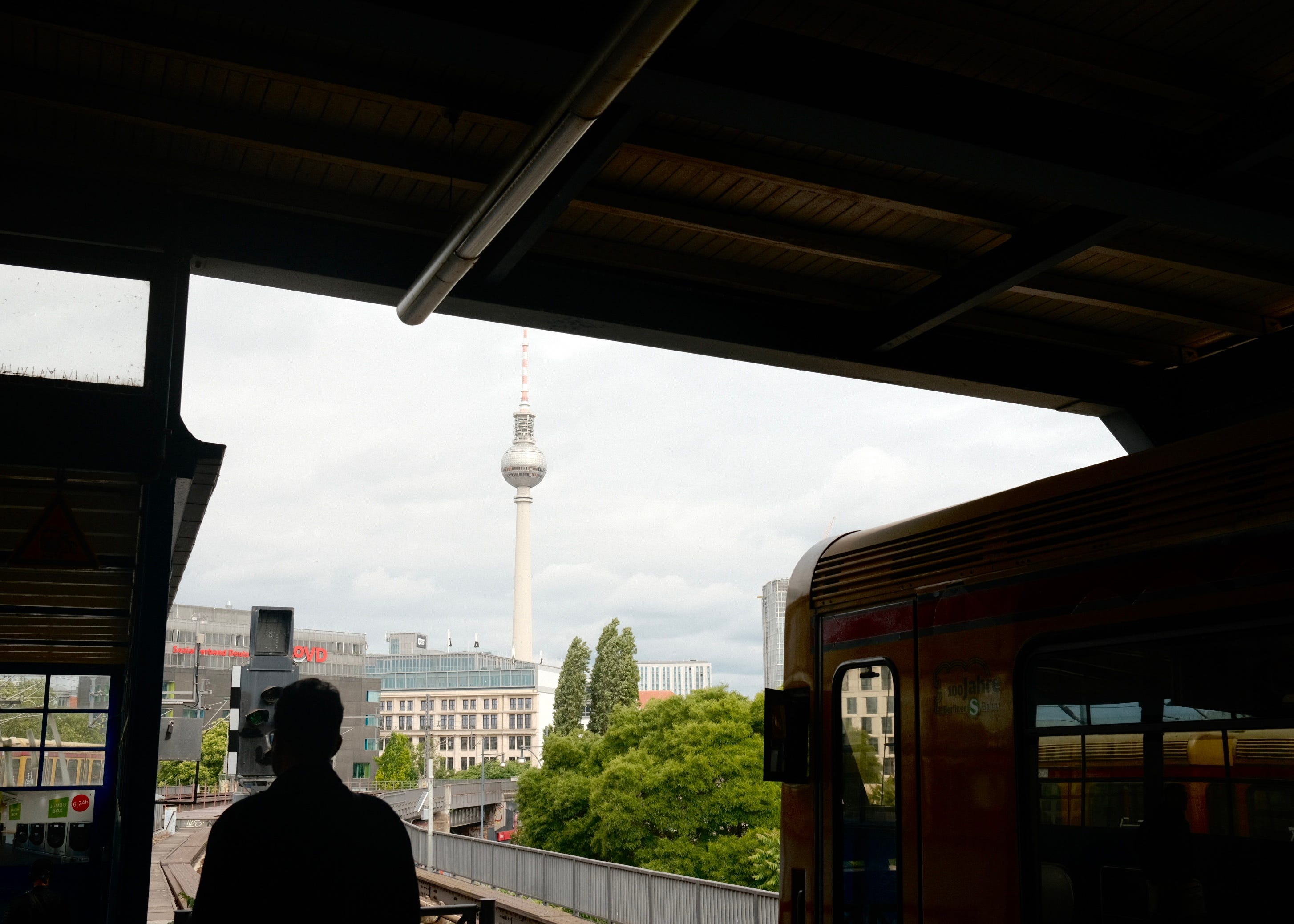
I recommend taking the train from Paris to Cologne to see Father John Misty at the Carlswerk Victoria. In Cologne the kebab shops, at least the ones open after a Tuesday night concert, are still selling cans of Coca-Cola from last Christmas. In Cologne you can get Kölsch, a pale, regionally regulated, light and refreshing beer, served to you in tall, thin glasses by servers (Köbes, auf Deutsch). The servers walk around, carrying several glasses at a time in a specifically designed tray (or Kranz). Each time you take a Kölsch, the servers mark it down in pencil on your coaster. When you’re done, they count up your tallies and they aren’t upset if you pay in cash. In Cologne, there’s the giant contemporary art museum, Museum Ludwig, featuring art from Warhol and Picasso, which you’ve already been to once before, but years ago. On this trip there’s an exhibit by Yayoi Kusama, whose Infinity Mirror exhibit, which is a dark room enclosed by mirrors and full of dangling strings of dim lights, meant to re-create with some authenticity her life, a life afflicted by schizophrenia, you’ve experienced once before in another part of the world, and while you’d like to see her exhibit in Cologne, an exhibit which is both grander and more varied, offering a more textured look at her unique way of seeing, you only learn about the exhibit on arriving in the city, and the expo is booked an entire month in advance. Instead if you want, you can go to Saint Ursula’s Church, to see the few and scattered bones of some 11,000 virgins who, on pilgrimage, were martyred (i.e. killed, by the Huns) in Cologne. Heinrich Böll, a German short story writer and novelist, a son of Cologne, who wrote Trümmerliteratur, that is rubble literature, (in)famously said that you could now (when he said this, now was post-World War II Germany, in the thick of the rubble of a country destroyed) use a single wheelbarrow to transport all the virgins who remained in Cologne. When people complained about his crude comment, he quipped with, “But I didn’t say how many trips you would have to take.” And of course there’s the cathedral, you can’t miss it, not because it’s giant, but because the train station you arrive at is in the shadow of the cathedral, but unlike other monuments, like say the Fernsehturm in Berlin, the cathedral doesn’t loom for long. It’s quickly out of view, forgotten, as you make your way deeper into the city.


You can stay on Mauritiussteinweg which, while a loud street, is close to Neumarkt, which is perfect because if you’re in Cologne you can attend the Wein Messe with Leyla, a friend you had met years ago on a pub crawl in Edinburgh. She has a square face and soft eyes that get softer the more drunk she is. On a park bench near Hin & Weg, where the two of you get coffee and a beer on your second day in her city, she shows you a new tattoo on her right arm, of the year 1876, which is the year her favorite painting, Bal du moulin de la Galette, by Renoir, was painted. The painting itself is in your home-city, so several days after your Cologne-Berlin trip is over, you can head to Orsay, to the fifth and final floor, where the painting hangs, surrounded as usual by clusters of tourists. You never much admired the work, and you still don’t quite see what Leyla sees, nothing that you’d want to get inked for, but you do look at the scene — a festive Sunday afternoon in Montmartre painted in blurred sun-stained strokes, like a photo oversaturated and out of focus — with new eyes, the way you look at a woman who, though originally unappealing to you, becomes more substantial and more alluring, and as a result more attractive, when you observe the ways others have oriented their lives around her.
You can get cold brew and banana bread at The Coffee Gang. Their banana bread is different, which is not to say worse, than the banana bread you eat 1-2x a week at Kann Residence near Canal Saint-Martin, where the baristas put a dollop of espresso butter on a thick, dense loaf of banana bread, and laugh a little at you, as you’ve been ordering the same order for the last year. At The Coffee Gang, the bread is less dense, thinner, and covered in powdered sugar not butter. The cold brew is weaker; you’ll order two each time you’re there. One to drink in the cafe, which is a laptop free zone, as you read through War and Peace, the book you’ve taken with you for this trip, as you’re part of a reading group traversing the massive Russian novel (that Tolstoy himself said was not a novel), and need to read roughly 150 pages a week to stay on track, and then another cold brew to go, which you’ll drink through a quickly collapsing paper straw as you walk through the city or sit in front of your laptop at your Airbnb, revising an article for work.
As you leave The Coffee Gang, powdered sugar sprinkled across your shirt, you’ll see a homeless man, his back to the Herz Jesus Catholic Church, his pants down around his calves, having a shit. He’ll stare at you, even as you avert your eyes, as a dog stares at its owner while squatting in a park, as if the owner had caused this embarrassing moment.
In a text to a friend, you’ll struggle to find the words that best describe Cologne. Some adjectives, like sketchy and run-down and poor, while true, read as distorted when singled out. But if you call Cologne beautiful and lovely, both of which are also true, you’re not doing the city justice, for anything worth describing, ought to be described in whole. You’ll settle on the word: authentic.
On the evening of the Wein Messe, Leyla will get wildly drunk and leave early, her wine-soft face wet from the rain that will fall arrhythmically for the whole of your Cologne to Berlin trip. But don’t worry, you can drink with her friends, one of whom, as she gets more drunk, speaks to you in French. After the event is over, two of her friends will take you to Hotel Lux KGB Bar, which is a Russian/Soviet themed bar, tended by a Ukrainian with a bowl cut, which is a bit like if a butcher shop was staffed by the livestock, and you can drink there with these new people, and fish all the cash you have out of your wallet to help pay for the beers and the khinkali and the khachapuri with an egg in the middle, and you can share a joint with Peter and Amina on a park bench, not far from the church where the homeless man had had a shit earlier. You do not know these people. You will not speak to them again. You’re living proof of the number of small anecdotes, of small connections, a person can accumulate without ever feeling tethered.
Instead of going back to Paris from Cologne, you can take the train to Berlin. It’s a 5 hr trip, no changes. That’s just enough time to get settled in and finish your week’s reading of War and Peace. On the train you’ll read the scene where blundering Pierre challenges his once-good-friend Dolokhov, who is sleeping with his wife, to a duel. Pierre himself is also a bit of an outsider. His real name is Pyotr, but he is called Pierre by everyone, both in Saint Petersburg and Moscow, a call-back to the fact that his father had him educated abroad, sure, an indicator of the times (speaking French in Russia was fashionable then), sure, but also calling Pyotr Pierre further separates him from the world he struggles to inhabit, the world where he embarrasses himself at high-class parties (championing Napoleon as someone to emulate, not to hate), where he shames his dying father (by drunkenly helping Dolokhov and another friend tie a police officer to a bear, throwing them in the river for a laugh), where his marriage to the beautiful Hélène was mostly forced upon him, where friends can stay under his roof and sneak into her bed. Oh, Dolokhov. He is clearly a villain, at once conniving, manipulative, cruel, and clever, but you struggle to hate him. While others in the novel, including Pierre, cause harm via good intentions or by not thinking at all, Dolokhov calculates his wrongdoings, to maximize both his personal pleasure and place in society (which means his harm does at least have a limit). In the tense duel scene, which, like all the best scenes in the novel, feels forced by external circumstances, that is, inescapable for these poor characters who, even the most rotten of them, simply want to live with meaning, Dolokhov surprisingly gets shot. As he is on the ground squirming to get up, Tolstoy has him “greedily” bite at the snow, wanting as much life as possible before it all goes away. That’s how you hope to go out, not necessarily getting shot in a duel for sleeping with a man’s wife, though God knows that’s possible, but still hungry for one more bite of life at the very end.
In Berlin you can meet up with Iliyana and Paul (names not changed). Iliyana, born and raised in Plovdiv, Bulgaria, has lived in Berlin for years and recently earned her German citizenship. Paul, her boyfriend, is German but only moved to Berlin two or so years ago, to be with her.


Iliyana will take you to the Alte Nationalgalerie, where you can look for a painting that you won’t be able to find, yet refuse to ask for help, for a museum is a closed loop and nothing here should be lost upon you. You can lap the gallery twice, before finally breaking down, at Iliyana’s third insistence, and asking the attendant who explains that the painting is in restoration. Still there will be much art to see and admire, including the first painting in the gallery below, which is Iliyana’s favorite.


Iliyana herself paints. Her apartment, which she shares with Paul, is full of her art. Inside her home, you’ll remember how the two of you met. On a night in May, years ago, before you ever lived in Paris or even thought of living in Paris, on a pub crawl in Sofia, you first met her as a blonde (except for the roots) with cracked hands (from boxing) who wore a baggy black hoodie and a baggy pair of black pants and trendy white, thick-soled sneakers. You thought she was “so Berlin” and that a person could be easily summed up by describing the city they inhabit. But as the night went on, she slowly came undone, which is to say, the Berlin side of her, the affected side of her, the side of her she had cultivated for years as a stranger in a stranger land, shed away, and in your memory, though this can’t possibly be true, her hair grew more wild and vibrant, both more blonde at the strands and darker at the roots, and stylized in an unruly way, like how hair gets after a day swimming in the ocean only to be dried by the afternoon sun, and then at the last club of the night, when everyone else from the pub crawl was getting ready to go home, she stripped off her black hoodie and revealed a colorful top, like a pink sparkling gel pen that exploded in the sun. That’s what it’s like standing in her apartment, coming out of the cold greyness of Germany and into something warm and colorful, where a disco ball hangs in the corner, where on every wall hangs at least one of her paintings, all of which are colorful and bright and, like the artist herself, insist on being recognized. You know all you need to know about Paul, not because of any conversations you’ve had, though you will have some that stick with you after your trip, but because he has chosen this place, this woman, to call home.
You yourself can stay (relatively affordably, by Berlin standards) in Teresea’s Airbnb at Engeldamm 64. The apartment is, if you compare it to the apartments you used to rent back in Mesa, Arizona, small, but you haven’t lived in Mesa for over 5 years, so now you compare apartments to your past Airbnbs and temporary apartments in Paris, which is to say that Teresea’s apartment, which is a studio with high ceilings and thick, reconstructed walls, feels grand, much more grand than your current little studio in the 10th arr. of Paris, so you make sure to spend some time at Engeldamm 64, sitting on the couch working — how nice it is to have a proper couch, one you can yawn into — or lying there awkwardly, your neck propped up, in TikTok viewing position, taking a break from Tolstoy’s epic to read Nabokov’s very short story, "A Guide to Berlin.”


In the story, the narrator is telling his friend of all the things important to him in Berlin, things like “visiting the amphibian, insect, and fish houses” at the Berlin Zoo, in the wintertime, when the “tropical animals [are] hidden away,” or of the “unusual hands” of the trolley conductor, that work “nimbly as those of a pianist,” but are also “so coarse that when you are pouring change into his palm and happen to touch that palm, which seems to have developed a harsh chitinous crust, you feel a kind of moral discomfort.”
One night drinking with Pauliyana and their friends, you’ll go to take a piss in a smoking allowed bar, after KBBQ and soju, after a cocktail and beer, feeling quite good and warm, that perfect combination of alcohol and socialization, which is the engine that drives the entire night but then as always you go a bit too far, and the next morning the engine stalls, choking on your social anxiety, as you check and re-check all the things you said the night prior.


When you come back to the table you’ll find that Paul had grabbed your camera while you were gone and now you have photos of people you cannot name, but know intimate details of, and a selfie of Paul, where he’s bearing a bright full-toothed smile beneath the blur of an out-of-focus shot.


The next day you and Iliyana can visit Berliner Dom, that’s Berlin Cathedral, where you can get the free audio tour but forget to listen to a single word. You will both be shocked by the cathedral’s beauty, its calmness, its scope.
At the top of the cathedral, with a panoramic view of the city, you’ll record a video of people down below walking through a grassy area, like a moving painting, pointillism come to life. Without intending to, you’ll pick up what Iliyana is saying.
“I used to sit down there, clear my head,” she says, in the video that you will replay a few times after your trip, “and I’d think ahead for the days where I’d have friends in this city, friends that I could sit there with.” Someone she could talk to about “utility pipes, streetcars, and other important matters,” as Nabokov put it, he himself no stranger to the loneliness of expatriation, “about all the times that [she had] glimpsed somebody’s future recollection.”
And she doesn’t say this next part, but surely, while she does have friends now, and a loving boyfriend, and a blessed mix of people to visit in this world and people who will visit her, and an apartment whose interior matches her heart, still a version of herself must exist, down at the grassy park, a version of this person who feels the burden of communicating daily in either her second or third language, who lives in a city where the original motivations for moving there have surely been lost, replaced with newer and often contradicting or fleeting motivations, where there are days (weeks? seasons?) where she isn’t (like so many of us) sure why she’s there at all, where the only reasons she can list are practical (after all, you’ve already spent so many years building one home, do you want to build another?) and just how long can practical reasons sustain you, you who have already led such an impractical life? You can relate to this, of course, for there are versions of you, versions that have longed for community and belonging, in parts of the world where you had no business being, where you had arrived anyway, often places you never returned to, yet where you had, despite the odds, found people to talk with and drink with, to confide in, to purely embarrass yourself in front of, people who had shown you hidden parts of their city and of themselves.